Key Takeaways (or TL;DR)
- Adoption of food delivery apps in Brazil is growing fast, with the market expected to reach $4.9 billion by 2034.
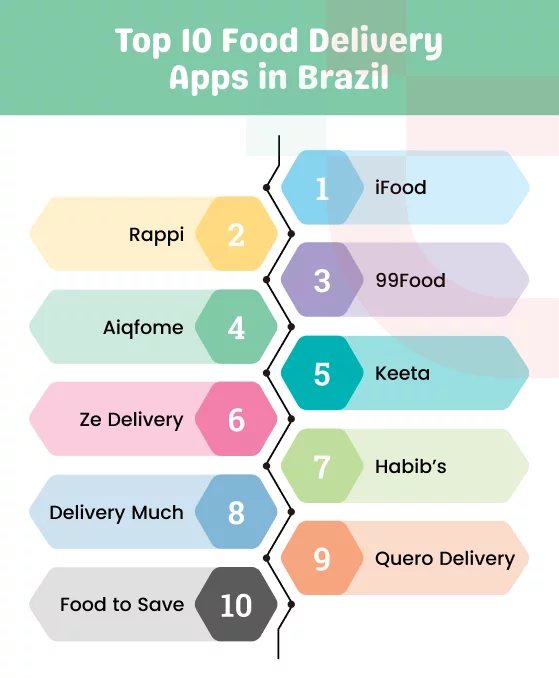
- The top 10 food delivery apps in Brazil are iFood, Rappi, 99Food, Aiqfome, Keeta, Ze Delivery, Habib’s, Delivery Much, Quero Delivery, and Food to Save.
- iFood is the major player, delivering over a million orders per month and operating in 1500+ cities, while Keeta is a well-funded food delivery app backed by the Chinese company Meituan.
- Regional platforms like Aiqfome and Delivery Much are fulfilling high demand in smaller towns of Brazil.
- Future trends in Brazil’s food delivery apps include AI adoption, hyperlocal delivery, expansion of quick commerce, and environmental sustainability measures.
Brazil’s online food delivery sector has grown drastically in the last few decades. It is now a competitive, technology-driven industry attracting billions of dollars in global investment.
Whether you are a startup considering launching a food delivery platform or an established entrepreneur looking to scale your operations in Brazil, knowing the top food delivery apps in Brazil is essential. It will help you understand how these platforms operate, generate revenue, and lead the market with powerful strategies.
This article will walk you through the top platforms operating in Brazil today, the business opportunities they offer, and what the future holds for this sector, so you can confidently start your food delivery business in Brazil.
Why Investing in Food Delivery Apps in Brazil Is a Smart Business Opportunity
Brazil is the largest digital economy in Latin America, with over 177 million internet users, creating strong opportunities for on-demand businesses.
Besides, there are several other reasons why investing in a food delivery app in Brazil can be a smart move for businesses.
Rapidly Growing Brazilian Food Delivery Market
Brazil’s online food delivery market has experienced significant growth over the past decade. The rise of app-based ordering platforms has helped many restaurants and cloud kitchens increase sales and reach customers who prefer ordering food online and home delivery.
According to recent research, the Brazilian food delivery market is expected to reach USD 4.9 billion by the end of 2034, with a 14.25% growth rate during 2026-2034. The market is expanding due to urbanization and consumer preferences. This highlights strong opportunities for businesses in the near future.
High Mobile and Digital Penetration
Brazil has one of the largest smartphone user bases in Latin America, with millions of consumers relying on mobile applications for everyday services such as on-demand taxi rides, online shopping, and food ordering.
According to Data Reportal, 217 million mobile connections were active in late 2025, which is equivalent to Brazil’s total population. High digital adoption rates confirm a tech-savvy user base, thus eliminating the need for businesses to educate customers on using the technology platform.
Permanent Shift in Consumer Lifestyle
Brazilian consumers prefer ordering meals online for better convenience. Working professionals, students, and growing urban households are mainly choosing to order meals rather than cook at home. A busy lifestyle leads to changes in how people manage time and spend money.
Thus, apps have become the default channel for ordering meals online whenever needed.
Expansion Potential Beyond Metros
While major cities like Rio de Janeiro and São Paulo dominate the food delivery market in Brazil, recent trends show that opportunities are also growing in smaller cities. With better internet infrastructure and growing awareness about food delivery apps, people in these areas are increasingly ordering food online. This opens up the ways for startups with limited budgets to launch and grow their food delivery businesses even in smaller Brazilian regions.
Launch a Scalable Food Delivery App in Brazil Successfully with Elluminati’s Strategic Guidance and Technology Solutions
Explore the Top 10 Food Delivery Apps in Brazil
Now, let’s have a look at the leading Brazilian food delivery apps.
1. iFood
It is the leading player in Brazil with over 80% market share in the online food delivery industry. The platform currently serves more than 1,500 cities and processes over 100 orders per month.
The major factor behind iFood’s market dominance is its advertising strategies. Besides marketing, the platform has transitioned itself from a mere food delivery app to a multi-service app by offering deliveries for groceries, pharmacies, pet supplies, and more.
Today, the company plans to expand its operations and improve the customer experience through AI. It recently announced an investment of $3.1 billion to enhance its logistics operations.
What You Can Learn: By gradually integrating multiple services in your app, you can lead the market in different verticals.
2. Rappi
Rappi is the second-most-popular food delivery app in Brazil, giving iFood a run for its money with ultra-fast deliveries, a super app ecosystem, and fintech integrations.
Customers can order meals, groceries, medicines, and more from the app and expect delivery within 10 minutes. To maintain its market position, Rappi is seeking to improve operational efficiency.
It uses smart technology and artificial intelligence to optimize logistics and manage supply chain operations. That’s why Rappi acquired Fountain9, the Indian AI startup, in 2024. In addition, the company also fully acquired Box Delivery (a local logistics company known for faster deliveries) to manage short-distance deliveries more efficiently.
What You Can Learn: By integrating multiple services into a single app, you can keep customers on your platform longer, thereby increasing overall revenue.
3. 99Food
This app is the subsidiary of China’s leading ride-hailing and food delivery company, Didi Chuxing. 99Food actually has a comeback story in the Brazilian market. It was launched in 2018 but shut down its operations in 2023 due to intense competition from the leading player, iFood.
Then it made a comeback in 2025 with support from its parent company and a large customer base on its ride-hailing platform, 99Taxis. It led the market through its competitive pricing strategies, which were driven by a unique 99 business model.
Besides, its financial arm, 99Pay, simplified daily transactions for restaurants and delivery partners, helping it attract and retain partners.
What You Can Learn: By following a strategic competitive pricing strategy, you can easily accelerate market entry and position yourself ahead of the competition.
4. Aiqfome
It is the second-largest food delivery app in Brazil in terms of city coverage, operating in 700 cities. Aiqfome serves the smallest Brazilian regions, rather than the metros that most national platforms overlook. And this becomes the company’s biggest advantage.
It was later owned by Brazil’s largest retailer, Magazine Luiza (Magalu), which has an active 50 million monthly user base. This helps Aiqfome easily access a large customer base through its parent company.
What You Can Learn: Targeting underserved areas is more effective than serving those already dominated by market leaders.
5. Keeta
This app is the fastest-growing new entrant in Brazil. With the support of its parent company, Meituan, the world’s largest food delivery platform, Keeta has been successfully operating in various regions, including Hong Kong, Kuwait, Saudi Arabia, Qatar, and the UAE.
Launched in Brazil in 2024, it scaled faster thanks to its low commission structure for restaurant partners, deep discounts for customers, and higher payouts to delivery partners.
What You Can Learn: By implementing proven revenue and growth strategies, you can easily lead the new food delivery app markets.
6. Zé Delivery
Owned by the world’s largest brewery, AB InBev, Ze Delivery is Brazil’s largest beverage delivery platform.
The app stands out by not aggregating with third-party restaurants. It directly sells beverages and snacks from its parent company’s supply chain. This means customers receive cold drinks and snacks at the same price they would get at physical stores.
Also, as the company maintains its own supply chain, it delivers ordered items within 15 minutes. Its ultra-fast deliveries allow the app to enhance customer experience and retain them for longer.
What You Can Learn: Instead of offering everything, focusing on any one high-demand product can help you lead the market in a better way.
7. Habib’s
It is Brazil’s well-known fast-food chain with a strong digital presence alongside its physical restaurants. Unlike aggregator-based food delivery platforms, which partner with third-party restaurants, Habib’s delivers its own menu to customers through its online ordering platform.
The company has been able to operate successfully because of its affordable pricing and wide reach. Besides, it frequently offers special discounts and offers to attract price-sensitive customers with ease.
What You Can Learn: It’s not always necessary to operate as an aggregator-based model. By having your own ordering and delivery system, you can control operational costs and increase margins.
8. Delivery Much
It is a regional delivery platform that mainly operates in small cities where leading giants have limited reach. Since its launch, it has grown into one of the largest food delivery apps in Brazil by building strong relationships with small-town restaurants.
Delivery Much offers personalized onboarding support, lower commissions, and locally focused services that national platforms rarely provide. With its focus on Brazil’s smaller cities, the platform has been able to expand its operations easily.
What You Can Learn: By keeping local region needs and your service providers at the centre, you can scale your business efficiently.
9. Quero Delivery
It is a growing regional platform that allows customers to order meals, groceries, and any fresh produce items like veggies and other essential products from a single place. The platform’s multi-service model helps it achieve a key market differentiation.
Besides, Quero Delivery operates in smaller areas of Brazil where people prefer using multi-category apps to switching between different applications. The platform is continuously expanding its restaurant network by implementing lower commission models.
What You Can Learn: Integrating multiple product categories into one app ensures a convenient shopping experience for customers and encourages them to use your platform more frequently.
10. Food To Save
Food To Save, the brand name itself, makes it apart from other food delivery platforms. Its approach is not just to deliver food; it also focuses on anti-food-waste delivery, allowing customers to order surplus items from nearby restaurants and have them delivered to their doorsteps.
The platform has become successful by creating winning situations for both customers and restaurant partners. Customers get quality meals at an affordable price, and restaurants can generate revenue from food they would otherwise throw away.
What You Can Learn: Opting for a purpose-driven business model helps you stand out in the market and also attract customers with ease.
|
Food Delivery App |
Services Offered |
What differentiates it? |
|
iFood |
Food delivery |
Large user base, fast delivery, strong network |
|
Rappi |
Food, grocery, pharmacy, cash delivery |
Multi-category platform |
|
99Food |
Food delivery |
Heavy discounts and free delivery |
|
Aiqfome |
Food, grocery, pet food |
Focusing on regional market needs |
|
Keeta |
Food delivery |
Zero delivery fee and heavy discounts |
|
Zé Delivery |
Drinks, cold snacks |
30-min delivery |
|
Habib’s |
Fast-Food delivery |
Operates its own delivery platform, which allows it to ensure quick deliveries |
|
Delivery Much |
Food delivery |
Low commission, strong local partnerships |
|
Quero Delivery |
Food delivery |
Affordable for restaurants, community-driven |
|
Food To Save |
Surplus food delivery |
Reduces food waste, discounted meals |
Future Outlook for Brazil Food Delivery Apps
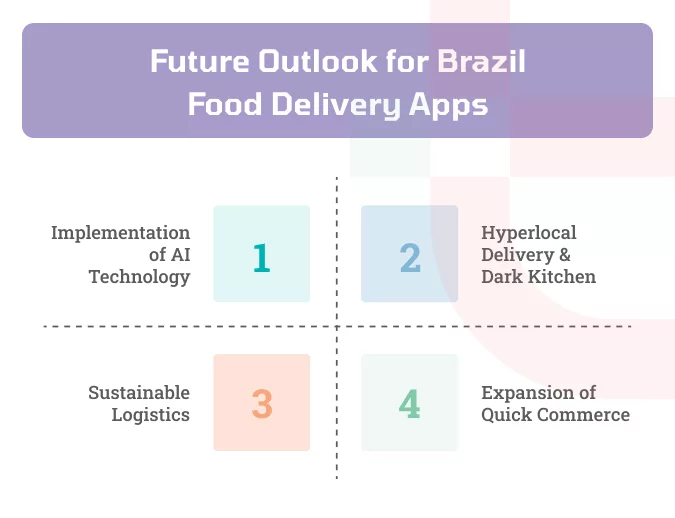
The coming years for Brazil’s food delivery apps will be defined by technology adoption, market consolidation, and regional expansion. Entrepreneurs who understand these trends can stay ahead of the competitive curve.
Implementation of AI Technology
Leading businesses are investing heavily in integrating AI into food delivery apps to improve the customer experience, enable predictive planning to reduce waste, and optimize routes. AI automated tools reduce delivery times, improve operational efficiency, and increase order volume.
Businesses are investing in drone deliveries and autonomous vehicles to expand their last-mile deliveries beyond standard platforms. Many existing apps like Meituan are already operating drone delivery at scale in China. That is why expecting a similar change in Brazil will benefit your business.
Hyperlocal Delivery and Dark Kitchens
Platforms are increasingly investing in dark kitchens, which are delivery-only cooking facilities without dine-in areas. These facilities reduce infrastructure costs and enable you to quickly test menu items, thereby increasing delivery speed in urban areas.
Hyperlocal delivery models, on the other hand, help fulfill delivery demand within a 2-5 km radius, which is becoming the new standard for operational efficiency. Entrepreneurs launching a new platform should consider dark kitchen partnership as a core operational strategy.
Sustainability and Green Logistics
Customers’ demand for eco-friendly services is growing rapidly in Brazil’s urban areas. And that is why platforms are now responding with carbon-neutral logistics, requiring restaurant partners to use eco-friendly packaging and to build strategies to reduce food waste.
Food to Save is one example of how sustainability can itself become a business model. New businesses that embed green logistics into their core operations will have a stronger regulatory value proposition.
Expansion in Quick-Commerce (Q-Commerce)
There is only a thin line existing between food delivery and grocery delivery, because major platforms are diversifying meal kits, diet-specific packages, beverage delivery, and everyday kitchen essentials, which increases order frequency and customer lifetime value.
Quick commerce represents a fast space for entrepreneurs to launch a grocery delivery app. A platform that can deliver groceries in under 20 minutes to a specific neighbourhood, at competitive prices, can easily build a loyal customer base that is difficult for large national food delivery players to replace.
Business Opportunities in the Brazilian Food Delivery Market
Understanding the competitive landscape gives you clarity on where your business can stand out. Here are five high-potential opportunities for entrepreneurs and established businesses in Brazil’s food delivery market:
Regional and Small-Town Expansion
Most small and medium-sized Brazilian cities are experiencing higher smartphone penetration. However, they have very few food delivery apps. This creates good opportunities for businesses to build an early brand presence in such markets before the leading players do. Partnering with local restaurants, integrating regional language, and offering competitive fees can quickly capture loyal customers.
B2B Services and “SaaS-like” Marketplaces
Independent restaurants oppose the 12-27% commission rates charged by dominant platforms, and that’s why SaaS-based platforms can be a flexible solution. You can own your branded app with a few customizations and address a genuine consumer pain point.
This model generates recurring subscription revenue and avoids the capital-intensive cost of operating a fleet, and scales well across multiple restaurant partners simultaneously.
Hyper-Specialized Verticals
Brazil’s food culture is rich and diverse regionally. As an entrepreneur, you can offer specific food categories, such as organic and regional cuisine, as well as meal plans for health-conscious customers. Selecting a specific category helps you build a strong niche community.
A real example of this is Food to Save; their success in the surplus food segment demonstrates that specialization is not a limitation, helping them reduce direct competition with other major players in the industry and creating a distinct customer segment.
Ecosystem Integration (Super-Apps)
A platform that integrates food, beverages, grocery, and pharmacy into one app drives higher order volume and stronger user retention. The multi-category model shows the potential to deliver household essentials beyond just food.
For instance, the Rappi business model, with a super app ecosystem, is particularly effective in Brazil because the market has a high proportion of mobile-first customers who prefer using a single app across different categories.
Logistics and “Para Entregadores” Solutions
The delivery workforce in Brazil is larger and growing at a fast pace. Platforms that offer integrated features such as route optimization, earnings transparency, and flexible payment modes build customer trust and loyalty among delivery partners.
Opting for logistics-as-a-service, where your platform manages deliveries for multiple brands and restaurants, is the best way to build a scalable B2B model. Startups can build this business as a standalone model.
How Can Elluminati Help You Launch a Food Delivery App in Brazil?
Brazil’s food delivery market is large and growing rapidly. By studying leading food delivery apps in Brazil, such as iFood, Rappi, Keeta, and Food To Save, you can understand how they are thriving in a highly competitive space. It also helps identify gaps in their services where you can create value and stand out.
The opportunities for entrepreneurs are clear: to build a profitable business, you do not have to outpace the competition; you also need to choose the right niche for your service and the right technology to execute your strategy and operations faster than others.
Elluminati, as a leading food delivery app development company, is helping businesses like yours turn strategies into a fully functional platform that aligns with your vision. Backed by over 14+ years of experience in developing on-demand solutions, we help businesses of diverse industries launch and grow effectively in the competitive market.
FAQs
iFood is the largest food delivery app in Brazil. It holds over 80% of the delivery market and processes over a million orders per month.
Profitability depends on your business model, commission structure, technology platform, and operational efficiency. Regional platforms and selecting a specific service category are more profitable than directly competing with major players.
The future of Brazil’s food delivery apps relies on AI integrations and the expansion of Q-commerce into groceries and essentials. Moreover, dark kitchen infrastructure and sustainability-focused logistics are new trends in the industry.
Yes, specifically for startups targeting regional cities, specific food categories, or restaurant partnerships. Entrepreneurs who focus on specific segments have a strong chance of building a scalable food delivery app in Brazil.