Key Takeaways (or TL;DR)
- The future of taxi businesses will be heavily influenced by AI, autonomous vehicles, robotaxis, electric vehicles, super apps, and Mobility-as-a-Service frameworks.
- There will be a massive business opportunity in Tier-2/Tier-3 cities, B2B rides, MaaS platforms, and EV fleets with innovative service models.
- Despite this promising growth, platforms have to come up with new solutions to tackle advanced challenges in driver retention, user economics, regulatory guidelines, passenger safety, and data privacy.
- Technologies such as AI, machine learning, and GPS will be leveraged to enable advanced features that meet modern requirements while keeping the business profitable in the long run.
The global taxi market is witnessing an exponential YoY growth because it has become a daily necessity for millions of people worldwide. The future of taxi businesses indicates a massive growth opportunity for platforms that know how to act on user demands.
However, there are new growth parameters to mind. Emerging technologies like autonomous robotaxis and multi-modal transportation frameworks have already started moving from testing labs to city streets. If you are not preparing for these changes now, you will be left behind.
This article aims to give you a bird’s-eye view of the future of ride-hailing businesses and touch upon key aspects to know to keep the taxi booking business flexible and future-proof.
What is the Future of On-demand Taxi Business?
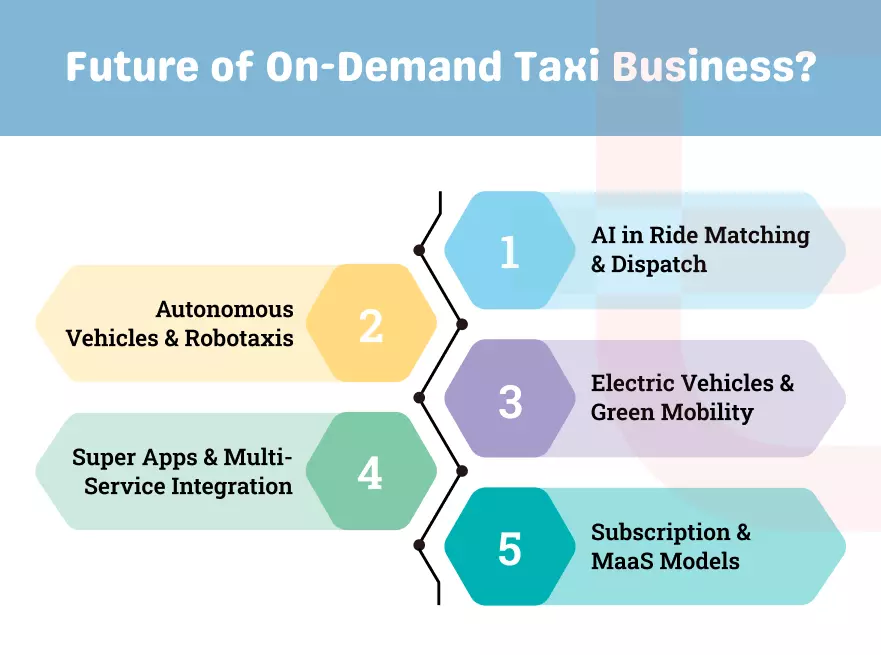
The future of taxi business will be driven by AI-powered dispatch, autonomous vehicles, electric fleets, and Mobility-as-a-Service platforms that combine multiple transport options into a single ecosystem.
Let’s see what role each technology will play in turning the industry from a reactive service provider to a predictive ecosystem.
AI in Ride Matching and Dispatch
Modern ride-hailing platforms will be powered by Genetic Algorithms (GAs) and Multi-Task Learning (MTL) to optimize how vehicles are assigned to passengers.
GAs can analyze thousands of combinations of passenger pick-ups and drop-offs with MTL to:
- Reduce passenger wait time
- Minimize detour delays
- Improve fuel efficiency
Also, AI can suggest ideal routes for low-skilled new drivers to find new passengers more quickly than traditional cruising methods.
Autonomous Vehicles (AVs) & Robotaxis
Autonomous vehicles (AVs) & robotaxis are going to be the future of the on-demand taxi business.
Robotaxis are Level 4 or Level 5 AVs. They transport passengers without a human driver present. The core technology used is Vision-Language-Action (VLA), which combines LiDAR, radar, and 360-degree cameras to process on-road visual data more like humans. If you know how to start a robotaxi business in the right direction, acquiring markets is easy.
The American autonomous driving technology company Waymo plans to expand its Robotaxis service to 27 US cities by the end of 2026. Tesla has recently launched its own service in Austin and the Bay Area, with plans to cover more cities by mid-2026.
The cost per mile for robotaxis is projected to drop to $0.30 – $0.50 by 2030. This means customers will find them 40% to 60% cheaper than traditional Uber or Lyft rides.
Electric Vehicles (EVs) & Green Mobility
Rising fuel costs and strict zero-emission rules will create a significant space for EVs and green mobility in the ride-hailing industry.
The global EV taxi market is expected to grow from USD 27.5 billion in 2026 to USD 90 billion in 2035, at a CAGR of 14.1%.
Fleet operators are quickly shifting from fuel vehicles to EV fleets to reach the break-even point in their investments much faster.
To meet the charging requirements, development plans for smart charging infrastructure are already underway. Dedicated EV lanes will include smart charging hubs to ensure taxis charge during off-peak hours, preventing grid overloads.
Super Apps & Multi-Service Integration
A super app is an all-in-one platform that hosts multiple independent services, such as mobility, food & grocery delivery, logistics, and payments. It starts with a high-frequency service, such as taxi rides, and gradually adds additional services to increase customer lifetime value.
The concept of multi-service integration aims to reduce app fatigue for users who now prefer a single application for all their daily needs. If a user books a ride to an airport, the app can automatically suggest a meal delivery for when they arrive home. That said, engagement rates are higher than those of single-purpose apps in the same category.
Popular multi-service platforms like Grab, GoJek, Yandex Go, and Bolt are leading examples of super apps.
Subscription & MaaS (Mobility-as-a-Service) Models
Mobility-as-a-Service (MaaS) is the future of on-demand taxi business platforms running on the pay-per-ride model. Instead of paying for every ride, users pay a flat monthly fee and can access different travel modes, such as taxi, bikes, or e-scooters.
MaaS platforms act as mediators that connect different transportation models into a single chain. Using a single platform, the user can book e-scooters to get from home to a transit hub, book metro tickets for the main trip, and book a taxi for rest areas not served by public transit.
Fixed monthly costs and reduced booking friction will increase user satisfaction, leading to quick adoption of the MaaS framework in the future.
Don’t Let the Future of Mobility Leave You Behind. Partner With Elluminati To Start Building a Future-Ready Taxi Platform Today
Business Opportunities in the Future of On-Demand Taxi Business
The global ride-hailing market is witnessing exponential growth. So, it is imperative to venture into untapped demographics and high-margin segments to retain profitability.
Let’s take a look at some profitable business opportunities.
Expansion into Tier-2 & Tier-3 Cities (Hyperlocal Growth)
The next billion users in the mobility sector belong to Tier-2 and Tier-3 urban cities. Users from these cities will heavily depend on shared mobility. A low percentage of private car ownership in many of these regions will also create a vacuum for reliable taxi services.
On the other hand, the hyperlocal services market is expanding, especially in urban areas. Taxi operators can capitalize on this by using their fleets for multi-purpose hyperlocal delivery (food, groceries, and medicine) during off-peak passenger hours.
Corporate & B2B Ride Solutions
B2B contracts offer stable, recurring revenue. As many companies transition back to hybrid or full-office models, corporate bookings are expected to offer higher margins than the volatile consumer segment.
Platforms just need to centralize invoicing, focus on passenger safety, and market carbon-footprint reporting for which corporations are willing to pay a premium.
Mobility-as-a-Service (MaaS) Platforms
To leverage the MaaS business framework, taxi apps must act as a connecting bridge of urban transit. For example, platforms can partner with public transport authorities to offer guaranteed trip assistance. If the train is late, a taxi will be automatically dispatched to the station at a discounted price.
Apps can integrate NFC (Near Field Communication) to allow for automatic payments through a single mobile wallet. By tapping the phone on a bus reader, the app will pre-book a taxi for the next journey.
Electric Fleets & Green Mobility
Ride-hailing platforms should aim to make EV fleets financially viable for users. For example, users earn eco-credits for every EV ride, which they can redeem for free rides or rewards. To further motivate users, platforms can offer a patience discount for choosing an EV over a gas car. AI can be super helpful for this kind of ride matching.
Challenges in the Future of Taxi Industry
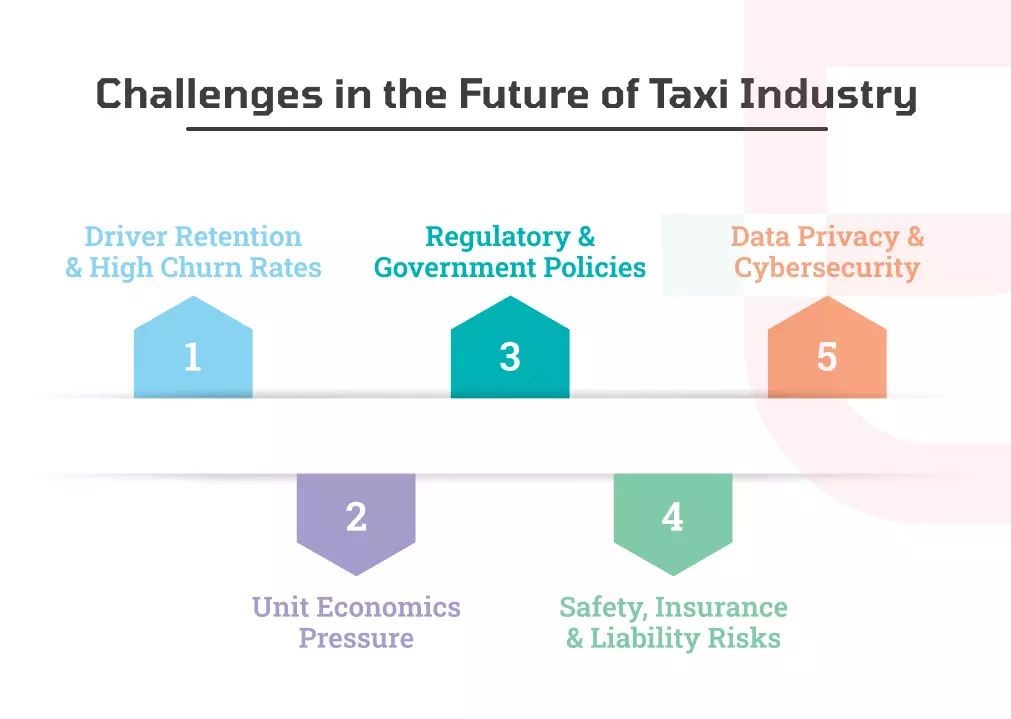
The taxi industry has already started facing a supply-side crisis. Despite high demands, platforms are struggling with a 25% quarterly driver churn rate. However, that’s not all. Let’s take a quick look at some major issues that could possibly challenge the future of taxi business platforms.
Driver Retention & High Churn Rates
The ride-hailing market is now full of many players. They are spending heavily on incentives just to keep their existing supply from switching to a rival. However, drivers, taking advantage of this competition, are constantly switching between apps that pay the best surge price for that hour.
Solution:
- Platforms can encourage their loyal drivers and customers with rewards based on ratings, completing a certain number of rides, etc.
- A guaranteed minimum payout during rush hours will also help in reducing churn rates.
- Alternatively, drivers can be offered a subscription that waives platform fees in exchange for a flat monthly fee (e.g., $50/month).
Unit Economics Pressure
After paying 70-80% of the fare, platforms are left with thin profit margins to cover insurance premiums, payment processing fees, and cloud infrastructure costs.
On the other hand, Customer Acquisition Cost (CAC) has surged by 40 – 60% due to digital ad saturation. Brands are spending $100 to acquire a customer to experience $80 lifetime value (LTV). This unsustainable LTV: CAC ratio is only attracting fickle users to platforms; they book only when charges are artificially low.
Solution:
- Platforms should consider subscription-led growth for a predictable, high-margin revenue stream.
- B2B programs now represent roughly 7% of total bookings in major hubs. Acquiring more B2B and corporate rides can help platforms to maintain a stable stream of income.
- With AI, platforms can reduce driver idle time, thereby minimizing deadhead miles (driving without a passenger).
Regulatory Uncertainty & Government Policies
There is constant pressure on taxi companies to operate under a patchwork of laws that vary from one country to another.
The second biggest challenge is to meet EV mandates. EVs will need to reach 75% to 95% of passenger vehicle sales by 2030. To meet that goal, governments around the world are using ride-hailing operators as the tip of the spear for climate action.
Solution:
- Platforms can train the software to automatically adjust surge caps, driver tax, and tax withholding in real-time as a vehicle crosses city or state lines.
- Apps are increasingly partnering with local fleet owners to avoid the risk of individual driver classification.
Safety, Insurance & Liability Risks
There is a need for strong passenger safety features in ride hailing business. Auto insurance is another tough line for taxi operators to navigate.
On top of this, liability ownership is another critical gray area. Coverage is subject to the driver’s app at the moment of an accident. There is a constant legal battle between driver personal policies and platform excess coverage.
Solution:
- Platforms can use multi-modal AI background verification to ensure the person behind the wheel matches the registered profile in real-time.
- Predictive AI monitoring can track harsh braking, erratic steering, or deviations from mapped routes and flag potential trouble before it escalates.
- Insurance premiums of drivers should be directly linked to their real-world behavior. Safer drivers will get broader coverage at lower premiums and vice versa.
Data Privacy & Cybersecurity Concerns
A breach in the fleet management system can immobilize entire taxi fleets for ransom. GPS data collection can be used by hackers to target high-profile passengers. The rise of agentic commerce is also posing the risk of a man-in-the-middle attack on payment flows. Fuel cards or digital wallets are the top target.
Solution:
- Besides encrypting data, platforms can tokenize card details or UPI IDs during transit for maximum protection.
- Role-Based Access Control (RBAC) can be another security layer. A support agent can see a rider’s first name, but cannot access their full trip history or unmasked credit card digits
Launch Your Sustainable Fleet Business With Confidence. Get the Tech Stack from Us That Makes EV Management and Green Mobility Easy and Profitable
Technology Powering the Future of Taxi Business Apps
Understanding the taxi app tech stack is important because it determines how platforms optimize their operational efficiency.
AI & Machine Learning
AI is useful for predictive decision-making. For example, instead of assigning the nearest available car to the user, AI can analyze factors to reduce the risk of ride cancellation. AI can automatically check the driver’s past ride records and behavioral ratings before making the selection.
It can also analyze local events, weather, and historical trends to alert drivers in advance of the rush and thereby reduce wait times. Algorithms can automatically incentivize drivers during rush hours to ensure the demand matches the supply.
GPS, Maps & Location Intelligence
Beyond location tracking, GPS is used for creating geolocation in ride-hailing apps (virtual boundaries) for important areas like power plants, airports, and college corridors. A continuous stream of GPS data can help the taxi company check if drivers are taking unnecessary detours just to increase the ride fare.
If the vehicle stops at a location for an unusually long period, the system automatically triggers safety alerts and prompts human agents to perform a manual inspection.
Payment Gateways & Fintech Integration
A strong fintech integration ensures transaction security between the rider, the driver, and the platform. As soon as a ride ends, the system instantly splits the fare between the driver and the platform, including fees towards local taxes and insurance.
Nowadays, super wallets are the new trend. A simple in-app wallet can integrate with the user’s UPI, cards, and reward points. Soon, these wallets will support blockchain-based tokens to pay for a multi-modal ride without requiring multiple transactions.
How Elluminati Can Help You Revolutionize the Future of Taxi Industry with the Right Foundation
The taxi industry is changing fast. To win in 2026, you need more than just a simple app; you need smart technology that can handle AI, electric fleets, and new business models. However, there is a risk of either overspending early on a heavy stack or falling for the wrong shortcuts.
If you have a great idea to revolutionize the future of taxi business ecosystems, but you aren’t sure how to build the right tech foundation, Elluminati can help. With over 14 years of experience as an ideal taxi app development company, our experts will guide you to the best tools for your business. We build custom, high-quality apps that help you stay ahead of the competition and grow with confidence.
FAQs
The future of taxi business is rapidly progressing towards autonomous robotaxis and EV fleets, powered by multi-modal super apps. Data-driven intelligence will be heavily utilized to benefit both users and platforms alike.
The biggest opportunities for the ride-hailing industry lie in rapidly urbanizing Tier-2 and Tier-3 cities, where users will find shared taxis more economically viable than privately owned cars. Also, the rise in B2B corporate mobility can offer a stable, predictable income stream when run by EV fleets.
AI is mainly used for predictive demand forecasting, dynamic surge pricing, and route optimization in taxi apps. The algorithm is very good at self-analyzing historical patterns to maximize driver efficiency and platform revenue.