Key Takeaways (or TL;DR)
- The on-demand business model is a digital platform-based model that connects customers with nearby service providers in real time to fulfil everyday service needs, such as taxi booking, food delivery, and home services.
- The on-demand business operates through a simple workflow in which customers request the service they need, and the platform matches them with an available provider.
- The on-demand service business model includes multiple types, such as ride-hailing, delivery, courier delivery, freelance marketplaces, and B2B marketplaces.
- Businesses generate revenue from multiple sources, like commissions, subscriptions, featured listings, and a hybrid approach.
- The future of on-demand business includes AI-powered dispatching, automation, a hyperlocal approach, and the adoption of sustainability solutions.
The on-demand business model has completely changed how customers access everyday services. Users can easily book rides, deliveries, and home services with just a few taps on a mobile app. At the same time, service providers get access to a large customer base without investing in physical infrastructure.
Studying this model helps entrepreneurs understand how to monetize their businesses while improving operational efficiency. This article will take you through the working process of an on-demand service business, its revenue strategies, and its future outlook.
What Is an On-Demand Business Model?
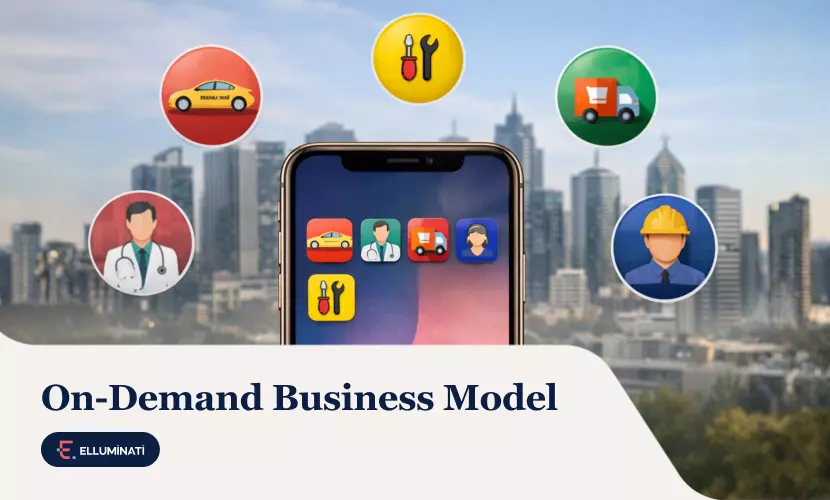
The on-demand business model refers to a digital platform that connects consumers with service providers when they need them. It basically works by matching demand and supply.
When a customer requests a service, the platform identifies the available provider and assigns the task. For instance, an on-demand taxi app connects passengers with nearby available drivers. In contrast, an on-demand food delivery app provides access to local restaurants and stores for online meal ordering.
Unlike traditional business models, which offer limited scalability due to fixed operating hours and the mandatory need for physical stores and inventory. The On-demand models are highly scalable.
Instead of expanding by launching more outlets, it allows expansion by extending its service provider network. Flexibility is one of the main reasons why businesses are adopting on-demand apps more.
This approach allows businesses to easily meet today’s customers’ expectations: speed and convenience.
How an On-Demand Business Model Works?
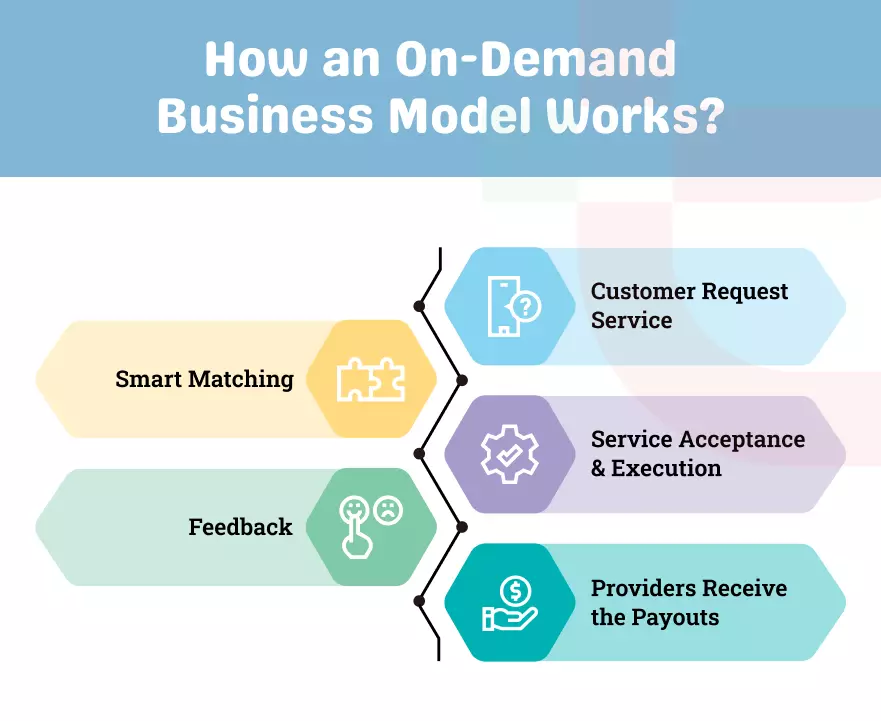
All on-demand business models follow a simple workflow. Customers request the required service, and the app matches them with an appropriate service provider. Here’s the breakdown of the entire process.
Customer Request Service
Initially, the customer logs in to the app and places a request by selecting the required service. They will provide their basic information, such as location, contact details, etc., and the platform will record the request.
Smart Matching
After receiving the request, the system analyzes it and routes it to the appropriate service provider based on their availability and location. The provider has the authority to accept or reject the request.
Service Acceptance and Execution
Once the service request is accepted, the customer receives a booking confirmation along with complete details of the provider. Also, the platform allows customers to track the status of the assigned provider.
Feedback
After service execution, both customers and providers may share their experiences through ratings and feedback. This allows businesses to maintain their service quality.
Providers Receive the Payouts
Also, the provider receives their earnings after the platform deducts its commission. Also, some platforms issue payments on the same day, while others transfer funds weekly.
Types of On-Demand Service Business Models
The on-demand business approach is not limited to any specific service type. It can be applied to various services, including delivery, courier, and ride-hailing. Here is the breakdown of the most popular on-demand service business models.
Ride-hailing
On-demand ride-hailing platforms allow passengers to book rides from mobile apps. These platforms have become widely popular due to the presence of established players such as Uber and Lyft.
Instead of relying on public transportation or searching for traditional taxis, passengers can easily arrange rides whenever they need them.
The best part is that businesses do not need to own any vehicles to serve this on-demand service. They can scale to multiple cities or countries easily by extending their driver and fleet operating network. This ultimately helps businesses save on operational costs.
Delivery
On-demand delivery services allow customers to order their desired products from the comfort of their own space. The service has become extremely popular through apps like Zomato, Instacart, and Doordash.
Post-pandemic, demand for delivery services for meals, groceries, and other daily essentials has increased. According to a recent survey by Data Intelo, the global on-demand delivery market size is anticipated to reach USD 899.4 billion by 2033.
It follows a straightforward approach where customers place orders, and the delivery app connects them with nearby providers based on the order type. Also, the platform provides a centralized place for businesses to manage daily operations, such as order processing, delivery partner assignment, and payments.
Courier Delivery
Courier delivery services are used for transporting packages, parcels, and documents across different locations. Businesses and individuals can rely on this model for timely shipments.
Although courier businesses that deliver parcels offline often face issues such as inaccurate location tracking and delayed deliveries, these can lead to a poor customer experience.
However, with the help of on-demand courier delivery platforms, such challenges can be overcome through live shipment tracking, smart route optimization, and centralized order management. This helps businesses ensure smooth customer experiences and efficient operations in the courier delivery space.
On-Demand Services
The on-demand service platforms connect customers with multiple service providers who offer services such as cleaning, plumbing, repairs, beauty, and more, all in one digital app.
On the other hand, it enables businesses to manage bookings and payments across multiple services. Urban Company business model is one such example that demonstrates how different services can be offered and managed easily through a single platform.
Freelance Marketplaces
The freelancing platforms connect companies with top-tier freelancers from across the globe through a digital application based on provided ratings, skills, and budget.
Earlier, finding skilled independent professionals was challenging for businesses. At the same time, freelancers found it difficult to find reliable companies to work on a contractual basis. Today, the entire process has become transparent through the on-demand apps.
Freelance marketplaces like Upwork, Fiverr, and Freelancer have transformed the gig economy into an easily accessible and trusted one.
B2B On-Demand Platforms
It allows businesses to sell their products online. Good-to-go examples for this platform include Amazon, Flipkart, and Myntra, which allow local businesses to extend their services by selling products online.
From groceries and electronics to fashion and lifestyle products, B2B on-demand platforms make it easier for customers to order the products they need anytime through a few taps on their mobile phone. Also, businesses get access to a large customer base, which helps them increase their earnings.
Launch Your On-Demand Business Quickly with Elluminati’s Proven Solutions for Diverse Businesses
Revenue Models and Monetization Strategies of On-Demand Service Businesses
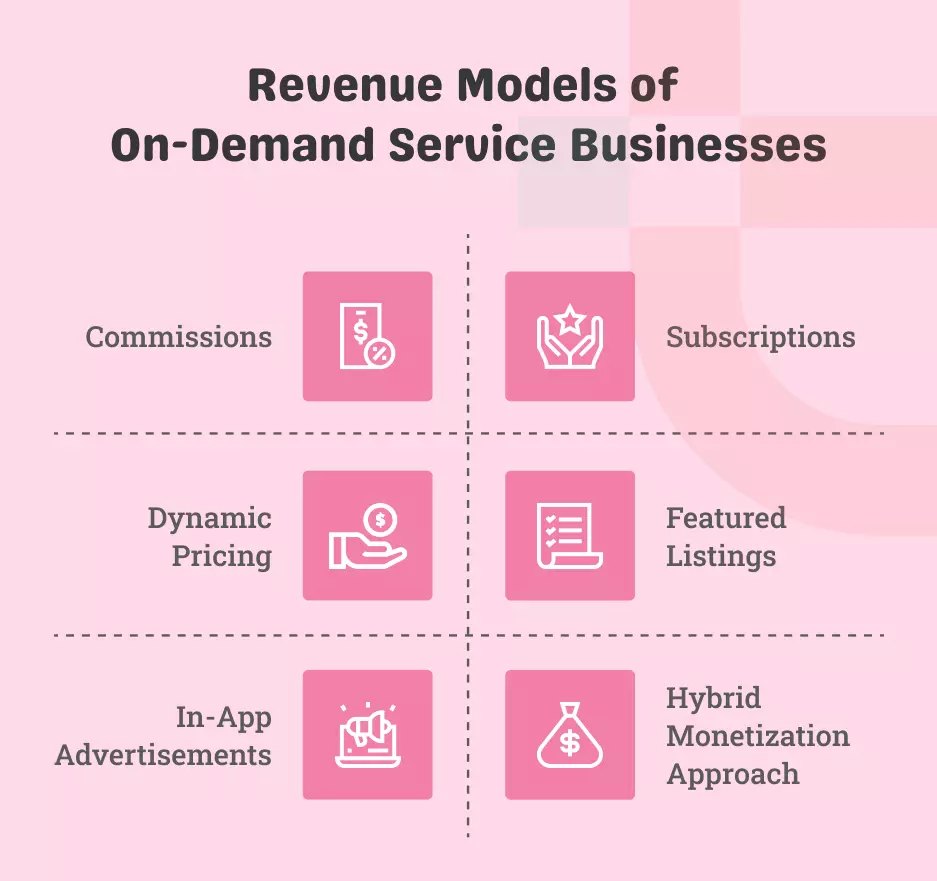
On-demand businesses generate income through multiple sources. Here’s a look at the most common on-demand service business revenue models.
Commissions
It is a revenue strategy in which the on-demand platform charges providers a set percentage fee for each service completed through the platform. This allows the app to generate income from each service.
Subscriptions
It is one of the steady sources of income, with users paying a recurring fee to the platform on a monthly or annual basis to access premium services. For instance, drivers receive the benefit of low commissions, while passengers get the advantage of prioritized bookings.
Dynamic Pricing
One of the immersive monetization strategies that most businesses use is dynamic pricing. Businesses can set high service costs for a specific period due to high demand, weather conditions, etc., and earn more by fulfilling the trips. It also benefits drivers by allowing them to earn extra money by serving during this period.
Featured listings
This is the promotional revenue model in which service providers pay a considerable amount to appear at the top of search results in the app. Featured listings allow providers to boost their visibility while creating an additional revenue source for businesses.
In-App Advertisements
It is a monetization strategy in which third-party businesses pay on-demand businesses a set amount to display their ads in the mobile app. This also creates an extra income source for businesses.
Hybrid Monetization Approach
Most businesses are adopting a hybrid monetization approach, as it enables them to not only cater to a diverse user base but also to generate income from multiple sources, such as in-app advertising, subscriptions, and more, within a single app.
One of the best examples of this is Uber. It generates income through multiple channels, such as its logistics and food deliveries.
Future Trends Shaping the On-Demand Industry
Now, let’s have a look at future advancements in technology and operations that would help on-demand businesses enhance their services in the coming years.
AI-Powered Dispatching
As the on-demand economy continues to evolve, many sectors are experiencing new business growth and expansion opportunities, and the dispatching system is no exception.
AI data analytics tools will analyze traffic patterns and customer locations to enable smart provider matching and route optimization. This will help businesses enhance operational efficiency and also ensure on-time service delivery.
Automation and Chatbots
This will help businesses automate repetitive tasks such as booking confirmations and real-time updates, allowing them to focus on more intricate tasks. Moreover, AI-powered chatbots will enable businesses to resolve user queries and disputes instantly, thereby delivering satisfactory user experiences.
Subscription Economy Blend
To attain long-term customer loyalty, many on-demand businesses will be executing a pay-per-use model in subscription plans where customers will be paying only for the services they use.
For instance, customers needing free delivery or priority access will pay for subscriptions to these services instead of purchasing complete packages. This will make subscriptions affordable for customers, building long-term loyalty while creating a predictable revenue stream for businesses.
Hyperlocal Expansion
Instead of expanding services to multiple regions all at once, businesses will grow strategically by targeting small and neighbourhood regions. This will help businesses maintain service quality and also prevent the need for heavy upfront investments, especially for startups that have limited budgets.
Sustainability in Logistics
With growing environmental concerns worldwide, businesses are opting for electric fleets, optimized routes, and eco-friendly packaging. This will help platforms attract environmentally conscious customers easily.
How Elluminati can Help you Build an On-Demand App?
Understanding the on-demand business model is the first step for startups to learn how to operate a successful, profitable business by streamlining daily operations such as booking and order processing. And for this, having a user-friendly on-demand app becomes essential.
That’s where Elluminati comes in as your technology partner. With experience serving 95+ countries and 840+ diverse projects, we have gained expertise in on-demand app development across sectors like ride-hailing, food and grocery delivery, and more. Partner with us to launch your on-demand business quickly and affordably.
FAQs
The on-demand business model is a digital platform-based approach that allows customers to request services like ride-hailing and delivery instantly through a mobile app.
The on-demand service business generates revenue through different sources, which include:
- Commissions
- Subscriptions
- Dynamic pricing
- Featured listings
- Advertisements
- Hybrid approach
Industries like delivery, ride-hailing, courier delivery, freelancing, and B2B marketplaces benefit most from on-demand service businesses.