Key Takeaways (or TL;DR)
- UrbanClap, which was rebranded as Urban Company, became a leading online service marketplace by leveraging strong operational strategies and competitive positioning.
- The Urban Company business model operates on a two-sided marketplace approach, connecting customers with vetted professionals for home, beauty, and maintenance services.
- It was among the earliest platforms to introduce enhanced safety measures for its service partners, including a real-time SOS helpline.
- The platform follows a streamlined workflow, where users can browse services, connect with professionals, make payments, and receive on-time services within the scheduled timelines.
- The company’s revenue model centers on charging commissions for services and lead generation through its subscription programs and other channels.
Urban Company, previously known as UrbanClap, is a well-renowned brand offering at-home services! It’s a one-stop service platform offering home, beauty, and electronics services via its mobile application.
For an entrepreneur looking to build an on-demand service platform, understanding Urban Company business model will be helpful. It demonstrates how structured operation, strong partner management, and diversified revenue streams can transform a local service into a scalable enterprise.
Now, to explore this transformation in detail, let’s take a deep dive into business strategies, how Urban Company works, generates revenue, and grows over time to expand its market reach.
About Urban Company: Exploring Its Business Expansion & Growth Timeline
Urban Company, formerly known as UrbanClap, is an Indian multinational platform operating in the rapidly growing on-demand economy, initially focused on providing beauty services at home.
Urban Company Overview:
Founded by: Abhiraj Singh Bhal, Varun Khaitan, & Raghav Chandra
Founded in: November 2014
Company Type: Public
Industry: Services, Consumer Electronics
Headquarters: Gurgaon, Haryana, India
Area Served: India, UAE, Singapore & Saudi Arabia
Services: Home Improvement, Handyman, Beauty Salon, & Home Appliances
Revenue: Increased by 33% year-on-year to Rs. 382.68 crore as per Q3 FY26
Over time, Urban Company has significantly expanded its footprint and user base, moving from a niche startup to a massive, publicly listed multinational company with a presence in more than 51 cities in India (mostly Tier 1 & Tier 2). Also, they entered international markets, the UAE, Singapore, Saudi Arabia, and Australia, with a user base of 12M+.
While widely recognized for home & beauty services, the company has also diversified into additional verticals that strengthen its revenue structure and long-term positioning, which include:
What Other Services Does Urban Company Offer?
Native
In late 2023, the firm shifted to becoming a manufacturing company by launching its smart RO water purifiers under its “Native” sub-brand. Also, they ensure that the Native M1 & M2 water purifiers are equipped with superior filters and rapid reverse rinse technology, requiring no filter changes or servicing for 2 years.
Insta Help
In March 2025, the company launched another sub-brand, Insta Maids, which was later renamed Insta Help a few weeks later, following feedback that it affected labor dignity. This service segment competes with players like Snabbit and Pronto.
Even though it’s just the base period for this new segment, it has already scaled to 1.61 million orders by the end of the quarter, bringing in Rs 28 crores in net transaction value, helped by strong customer adoption, retention, and repeat rates.
Revamp
The company announced its new sub-brand, Revamp, on 25th August, 2025, in Mumbai, with a focus on rapid, one-day micro-home makeover. It is currently available in cities like Mumbai, Delhi-NCR, Bengaluru, and Hyderabad.
Also, the CEO, Abhiraj Singh Bhal, takes a moment on X to share the basic purpose of Revamp: “from premium wall panels and integrated lighting to smart, modular furniture, Revamp offers 300+ curated looks to upgrade your living space instantly.”
Today, we give you a preview of our bold new sub-brand – Revamp
One-day micro home makeovers. International-quality designs and material. Zero hassle.
From premium wall panels and integrated lighting to smart, modular furniture, Revamp offers 300+ curated looks to instantly… https://t.co/OodJqeGG4e
— Abhiraj Singh Bhal (@abhirajbhal) August 25, 2025
Success Timeline of Urban Company
The rebranding and vertical expansion initiatives mark significant milestones in Urban Company’s evolution. To better understand its structured growth journey, let’s examine the company’s success & growth timeline:
- 2014: Founded as UrbanClap by Abhiraj Bhal, Varun Khaitan, and Raghav Chandra.
- 2015: Secured seed investment from Ratan Tata, providing an immediate brand trust in the Indian market for the company.
- 2016: Acquired GoodService, a hyperlocal concierge app, and HandyHome, a home appliance repair company.
- 2017: Transitioned from a lead-gen model to its full-stack model, and also partnered with an NSDC (National Skill Development Corporation) to standardize training & certify all service professionals.
- 2018: Marked its first footprint outside India with the launch of its operation in Dubai.
- 2019: Expanded its operations to Australia & Singapore. Later the same year, made a product supply partnership with L’Oreal & Diversey to create exclusive professional kits, ensuring workers used high-quality, standardized products.
- 2020: The company rebranded from UrbanClap to Urban Company to globally scale its brand identity and services.
- 2021: Achieved the Unicorn Club by reaching a valuation of over $2 billion.
- 2022: Launched health insurance and digital training for gig workers. Also, collaborated with the Invisible Scars Foundation (Project Nidar) to support women partners against domestic violence.
- 2023: Introduced the Native, a first in-house brand, and shifted to manufacturing operations with its Water Purifiers services.
- 2024: Expanded its Native brand and also included the Smart Locks. Also, formed a strategic alliance with NITI Aayog through the Women Entrepreneurship Platform (WEP) to support female micro-entrepreneurs.
- 2025: Introduced Insta Help to enter the quick-commerce market. Later in August, they also launched Revamp, a one-day home makeover service, and announced its IPO.
In late 2025, the company entered into a strategic partnership with Noon (UAE) to integrate its services into the Super App for Middle East expansion.
- 2026: At the start of 2026, the company made a partnership with an HDFC Pension to introduce its first-of-its-kind NPS (National Pension System) integration for its 20,000+ gig workers.
Now, we all know that the sustained growth has been supported by strong investor backing. Therefore, let’s take a look at its total funding over the past few years.
Funding Insights:
Following its IPO listing in September 2025, the company has raised approximately $605 million across 14 rounds.
|
Funding Rounds of Urban Company (From 2019 – 2025) |
||
|
Announcement Date |
Round |
Amount Raised (in USD) |
|
September 2025 |
IPO (Fresh Issue) |
Approximate $57 M |
|
July 2024 |
Secondary Round |
$50 Million |
|
June 2022 |
Angel Round |
$144K |
|
June 2021 |
Series F |
$255 Million |
|
August 2019 |
Series E |
$75 Million |
How Urban Company Work?
The firm didn’t just come up with an accurate, convenient solution for home services; it has already built a strong trust among its users. Specifically, when the impact of COVID-19 on on-demand service reshaped the market, the company served as a major catalyst.
Their hygiene and safety standards became key factors in users shifting from local to the company. And, its user-friendly app flow makes it easier for their customers to connect with professionals with simple steps, including;
Users Flow
- Using the app, the user can browse a categorized list of services and select the professional who best fits their requirements.
- After selecting the service, they must add an appointment date and time.
- Next, they make a payment, selecting their preferred method to confirm the order.
- The app’s algorithm smartly matches users with the nearest professionals depending on their availability.
- Once the request has been accepted, users can verify the details of the assigned professionals, including their ratings.
- At the end of service, the app asks users and professionals to submit ratings and feedback in real time, maintaining high network standards.
Service Partner Flow
- The service partner must first register on the platform by submitting their documents for background verification.
- Once verified, they can undergo mandatory training on service standards and skills.
- Also, they have to purchase or lease standardized, branded professional kits, such as chemicals and tools, as per their business requirements.
- Later, they can turn the Toggle On to indicate availability to accept the service.
- The app’s algorithm sends a notification about a new service request.
- After accepting the request, they can review the user’s requirements and accept them.
- Then the partner can use their integrated map features to track the user’s location and tap “Check-in” to start the job timer.
- Upon completing the task, they need to mark the job as finished and analyze a complete invoice summary.
- At last, the app asks partners to provide real-time feedback on users, maintaining the transparency throughout the flow.
Ready to Transform Your On-Demand Service Business? Partner with Elluminati to Develop a Tailored Urban Company Like App
Urban Company Business Model Canvas Explained
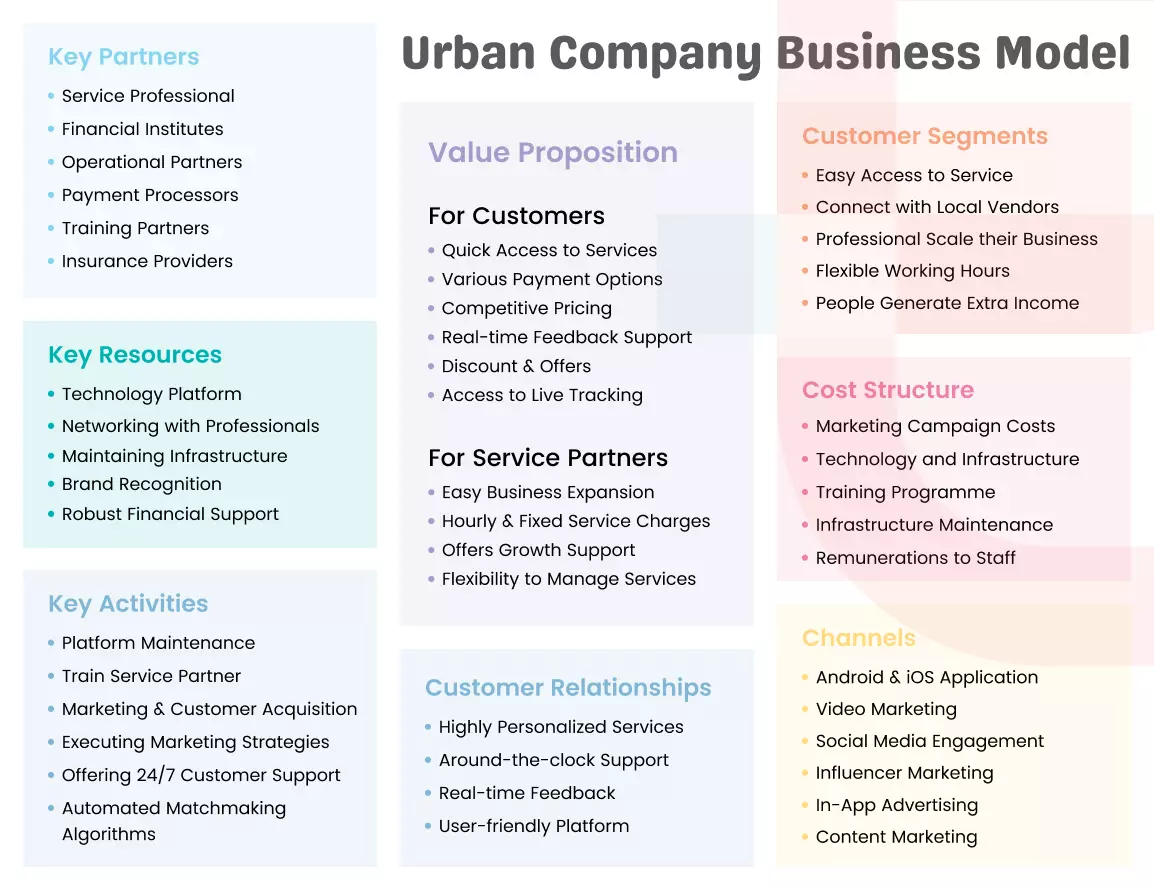
The Urban Company business model operates as a multi-sided marketplace connecting customers seeking on-demand services with verified service professionals through a single platform.
Key Partners:
- Recognized as a key backbone, the company formed a partnership with over 20,000 service professionals.
- The firm also has partnerships with major investors, including Vy Capital, Elevation Capital, and others, which contribute to its growth.
- A strategic collaboration with one of the well-known e-commerce platforms, Noon, to offer home services, including cleaning and repairs, directly using the Noon app in the UAE & Saudi Arabia
- Also, the firm had collaborated with HDFC Pension Plan (NPS) under the National Pension System to provide financial inclusion for all its service professionals.
- Engaged in technology and system integration partnerships to enhance platform performance.
- The company also joins hands with the Buyer to source professional-grade products for its pest control services.
Value Proposition:
For Customer
- Easy accessibility of multiple services through a single unified platform.
- Ensuring safety by analyzing all professionals’ backgrounds and verifying their tags results in consistent, high-quality service delivery.
- Competitive & transparent pricing while reserving any booking
- Monitoring all the activities of service partners in real-time.
- Offers various perks & benefits, including discounts & occasional offers.
- Pro-level subscription model that guarantees better benefits & easier access to services.
For Service Partner
- It enables them to easily connect with a wide user base.
- Quick expansion of the on-demand services into multiple countries & cities.
- It provides them with access to the platform’s training program to enhance their skills.
- Also, receives other financial & social security in the form of insurance.
- Flexible working model supported by a centralized technology system.
Key Activities:
- Maintaining the high service standards with ratings, safety protocols, and standardized pricing.
- Expanding the in-house product line into multiple sub-brands.
- Continuous investment in technology and data optimization.
- Strategically scaling operations across India, the UAE, and other international countries.
- Delivering structured training programs to enhance service performance.
Cost Structure:
- Expenditure for marketing and customer acquisition strategies.
- Training and onboarding costs for service professionals.
- Leveraging on heavy investment to upgrade the technology and infrastructure.
- Insurance coverage for their service professionals.
- Remuneration charges paid to the in-house staff members
- Other operational costs for maintaining the software, upgrading infrastructure, etc.
Understanding the Two-Way Approaches of the Urban Company Business Model
Beyond the points we have covered, here are the two-way approaches based on how the company primarily operates.
Fixed-Charged Services
For any service type, such as home cleaning, electrical, plumbing, or any other, the company accepts payment through the app and charges its fees to the hired assistance. Also, they cut a different fee off the collected funds.
Services Without Fixed Charges
Under this model, the company charges professionals for sponsored listings and lead generation. Here, the users don’t have to pay the amount right away. The professional first pays a fee to accept the company’s request, and if the professional successfully convinces users to buy their service, the monetization is completed.
Users are provided with five options; they can select any one as per their convenience. If customers don’t explore the provider’s profile, they receive paid credit. If the algorithm works effectively, users can get an immediate solution without much effort.
Launch Smarter, Scale Faster. Leverage Our Enterprise-Grade Urban Company Clone Designed to Streamline Your Operations.
How Urban Company Makes Money?
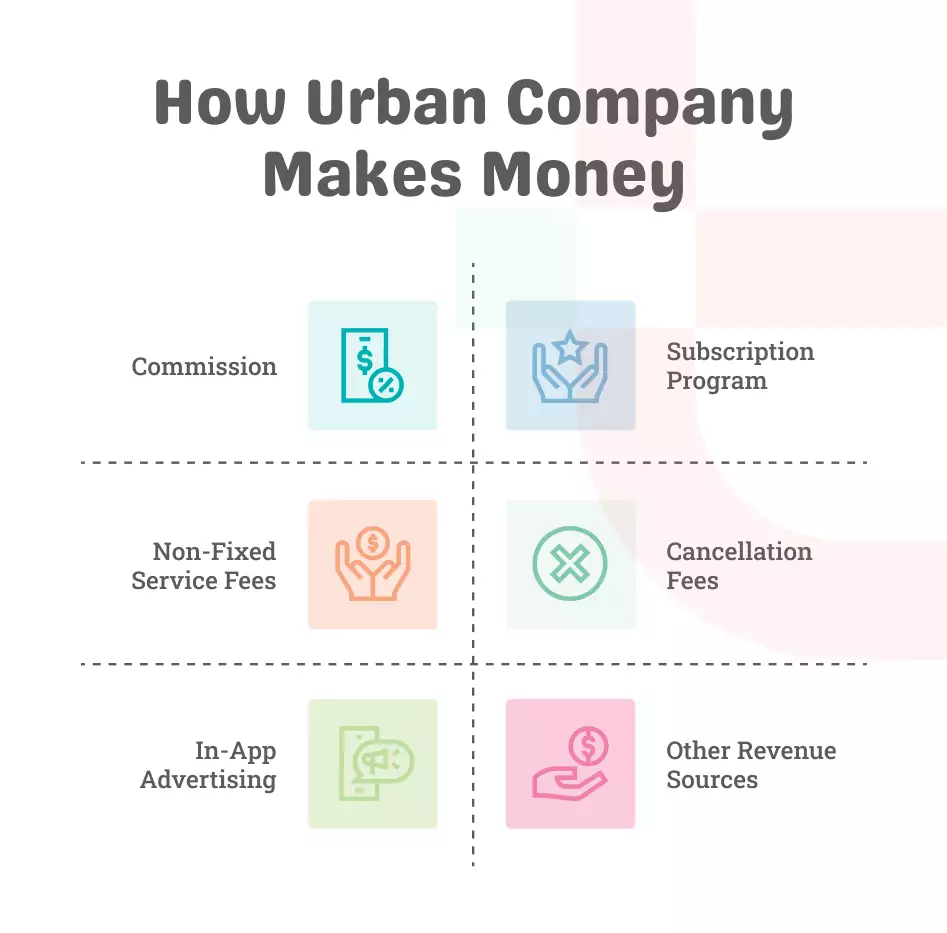
Instead of relying on a single revenue stream, Urban Company revenue model diversified its monetization models, including commissions, recurring subscriptions, and others, ensuring operational stability and long-term scalability.
Commission
The company generates the major part of its revenue from this commission-based model. For each service, the firm charges a commission of approximately 15% to 30% of the total value of services booked through the platform.
Subscription Program
Another steady source of income for the Urban Company is through its subscription program, designed separately for both its users and service partners.
- UC Plus for Users: This membership plan, starting at approximately Rs 399, offers perks and benefits, including discounts, lower service charges, priority customer support, and more.
- For Service Partner: Partners in the beauty sector can gain greater benefits from this program. They can pay monthly subscription fees that differ based on Prime (approx. Rs. 3000) and Classic (Rs. 2000).
Through this program, they will gain access to additional benefits, such as medical insurance for themselves and their family.
Non-Fixed Service Fees
Sounds interesting, but it is one of the unique approaches a company uses to generate income.
- Through Leads: Here, the company sells its leads in the form of customers’ contact details to the service professionals, and they will pay a fee for transferring the customer details.
- Reverse Auction or Bidding Model: Just like the general bidding flow, the company sends a customer’s request to multiple professionals, and the professionals, in turn, pay a few percent to the company in exchange for the opportunity to bid on the project.
Cancellation Fees
The firm also applies several cancellation fees in the form of penalties to users who cancel services within 24 hours of the appointment, and charges higher fees if it’s cancelled very late, up to an hour before the appointment.
In-App Advertising & Sponsored Listings
As the company already leads, many service providers, such as photographers and wedding planners, businesses, and manufacturers, run their advertisements as well as pay the Urban Company to appear at the top of search results.
Other Revenue Sources
From Other Sub-brands
Revamp
It is a project-based model in which the customer pays a consultation fee to a designer for their visit. But the majority of revenue is generated from full project costs, where the company manages materials such as paints, wall panels, and other materials.
Native
Under this brand, they focus on the D2C model, selling their RO water purifiers and smart locks to customers through platforms such as Amazon, the Urban Company website, and Croma.
InstaHelp
The company charges users an hourly rate ranging from Rs. 49 to Rs. 245, depending on the service.
Professional Kits
The company acts as a B2B supplier here. Every partner associated with the company or the platform must purchase branded consumable products, such as facial kits, specialized cleaning liquids, and toolkits, directly from the UC to maintain effective quality standards.
Training Program
The firm also operates a separate training program for the partners. Here, the partners are required to pay registration fees to enroll in the program, and the firm provides multi-day skill-upgrading training that qualifies them as certified service providers in the streams they focus on.
How Can Elluminati Help You Build an App Like Urban Company?
Capturing unique user needs, allocating manpower, and monitoring every operation are challenging; however, Urban Company business model considers all these elements equally, it identifies localized demands, and more, which makes it one of the successful marketplace models.
However, for entrepreneurs like you who are thinking of entering the wide market with your initial on-demand services, understanding how Urban Company works is no less than an inspiration. But turning this model into a functional application requires more than strategy; it demands expertise in on-demand architecture, and that is where Elluminati comes in.
With over a decade of experience across multiple industries, our team of developers analyzes your business to design a scalable Urban Company clone tailored to your needs. Our solutions help you manage and expand your on-demand business with operational precision and long-term scalability.
FAQs:
The Urban Company follows a structured workflow, enabling users to easily connect with professional service providers and reserve appointments to receive services within a specified time period.
Urban Company revenue model primarily includes:
- Commission Fees
- Subscription Program
- Non-Fixed Service Charges
- Cancellation Fees
- In-App Advertising
Urban Company provides a wide range of at-home services, including:
- Beauty & Spa
- Cleaning
- Home Maintenance
- Appliance Repair, among others
The Urban Company business model primarily operates as an online marketplace for home services, connecting customers to reserve their preferred service types while allowing multiple service partners to serve on a single platform.